
Into the Woods I Go
...but maybe not with John Muir

Since I am in the business of making personalized woodcut items with nature themes, I get a lot of requests that include nature-adjacent quotes. I’ve engraved “Not all those who wander are lost” from The Fellowship of the Ring more times than I can count.
But one quote beats even Tolkien for frequency. And it is always misattributed.
“And into the woods I go, to lose my mind and find my soul.”
This beautiful, if slightly imperfect, sentiment is typically attributed to John Muir. But there’s no evidence that he actually said it.
If that’s news to you, I’m sorry to have been the one to have broken it. Sit down for a moment, and collect your thoughts. I’ll put on some tea and we can talk about it.
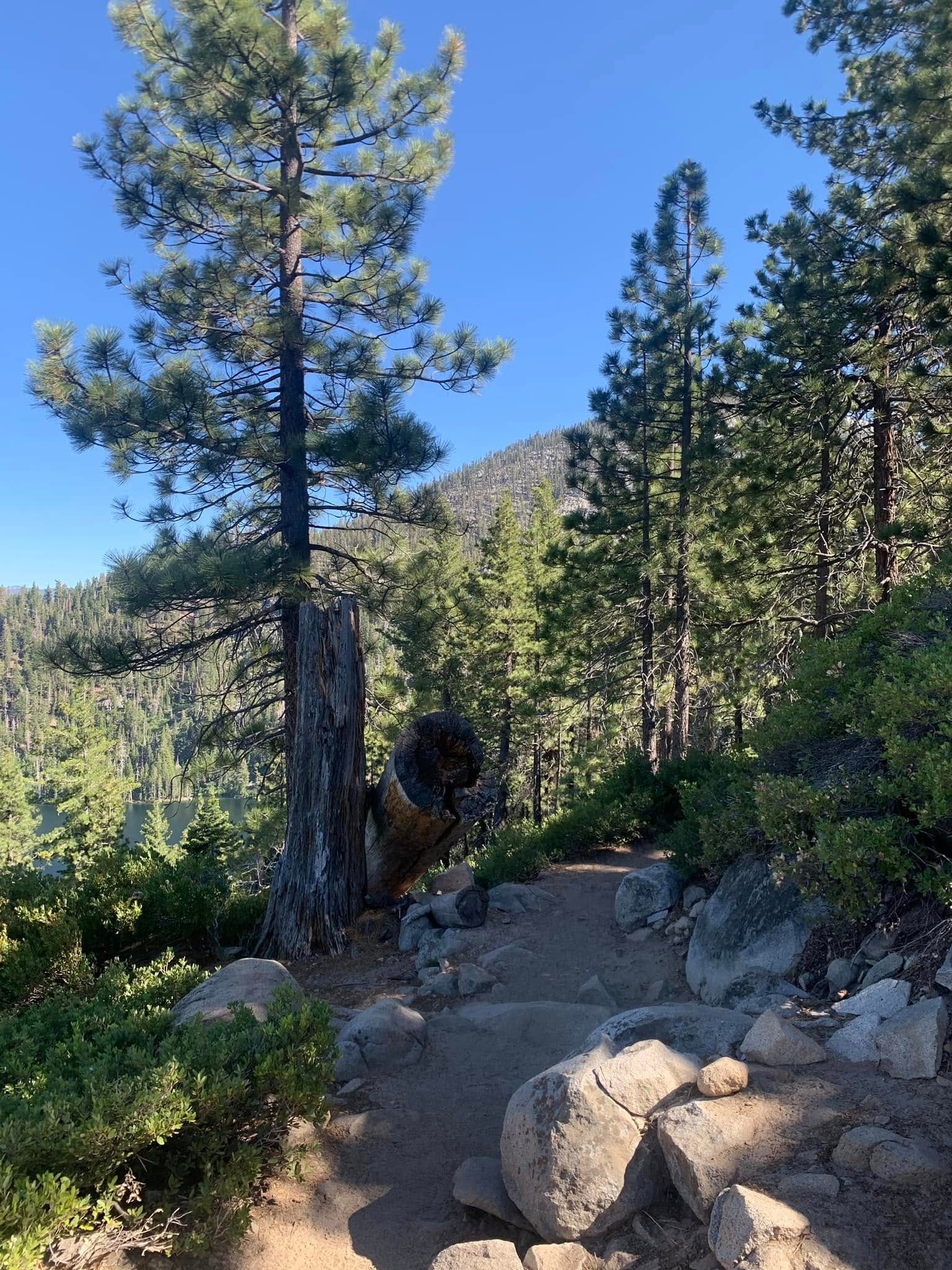
Photo: a beautiful trail in Tahoe.
I came across this quote misattribution the way most of us stumble into modern philosophical crises: casually, and with enough disbelief to inspire me to dig for the truth.
After all, the quote feels right, mostly. It aligns with everything we think we know about John Muir, the wild-haired prophet of the Sierra, the man who insisted that going to the mountains was, in some essential way, going home.
But something about it always felt off. “Lose my mind” is a strange choice of words, isn’t it?
Losing your mind typically has a negative connotation. If I hear that Chappell Roan song on the radio one more time, I’m going to lose my mind. That’s not exactly the calming, soul-discovering experience we tend to associate with nature.
Moreover, Muir’s actual writing doesn’t sound like that. His voice is more precise, more observant, more grounded in the physical world. He went into the woods to study and observe, to catalog and understand.
And yet, there is something underneath all of that. He notices how water moves, how wind travels, how trees lean toward each other. His work is rooted in science, there’s something more in his devotion to nature that lingers just beneath the surface.
Which is probably why the quote keeps finding its way back to him. It feels right.
There’s another quote of his, this one real, written in one of his journals:
“In every walk with nature one receives far more than he seeks.”
This one is less dramatic than losing your mind and finding your soul. In in that way, it is probably a little closer to the truth. We aren’t usually transformed by a trip to the forest in some sweeping, cinematic way. You go, you notice more, you carry less. You come back slightly rearranged in the best possible way.
If we’re going by feel, that feels a little more like Muir. But if he didn’t say it, then who did?
The answer is less satisfying, and somehow more interesting.
The quote appears to be modern. It circulates widely, but without a clear origin. No journal entry, no published work, no dusty letter tucked away in an archive. No Livejournal entry. It’s a sentence that seems to have simply appeared, fully formed and unattached.
A ghost quote. And like most ghost quotes, it found a home in the nearest available body.
This happens more often than we’d like to admit.
If a line sounds wise and nature-y, we hand it to John Muir.
If it’s rebellious and poetic, it probably gets pinned on Mark Twain.
Witty and razor-sharp? Oscar Wilde.
And if it’s vaguely spiritual and just a little abstract, Rumi is standing by, ready to take the credit.
It’s less about accuracy and more about fit. We match the tone of the quote to the vibe of the person, like pairing a wine with dinner. Close enough.
And it’s easy to see why this one stuck to Muir. Because even if it didn’t come from him, it points toward something he understood deeply: that being in the woods changes you. That the constant, low-grade noise of everyday life, the lists, the deadlines, the static hum of worry, starts to fade at the edges. Not dramatically or all at once, but just enough to feel like yourself in a way that’s hard to access anywhere else.
So no, John Muir probably never said it. But there’s no doubt he would have recognized it. And, attribution aside, it’s a sentiment many of us carry with us every time we step into the woods.
This quote has always bothered me on some level because I never have liked the connotation of losing my mind. So I’m glad that Muir probably didn’t say it. Thank you for this clarification.
hey Jenn, just a quick note about Substack and the-algorithm-of-what-AI decides I should see in my feed..... today, I was all like, "I wonder why Jenn Colins has been so quiet here?" searched you, and found a bazallion notes I hadn't seen. Like AT ALL. Seriously Substack WTF?
Hrmph. I have been getting the same like 5 people's posts/notes over and over. And over. Sometimes the same post repeated 5 TIMES.
I guess I can't rely on the AI slop shop and I will have to search out the people I want to see.
So sorry for flooding your notifications with ❤️.
Oh and PS: love this post. misattribution is so rampant, I have to use a fact checker all the time.
Sigh. "And so it goes" (Kurt Vonnegut, and 100%).